• About The Mild Mannered Professor Mysteries
  • Shorts

The Mild Mannered Professor Mysteries

~ Wholesome stories about unwholesome motives and deeds with occasional notes about writing.

The Mild Mannered Professor Mysteries

Category Archives: About the The House at Mt. Tabor

Occasional note: Postpartum Blues and Black Holes

29 Saturday Nov 2014

Posted by Frances St.Clair in About the The House at Mt. Tabor, The House at Mt. Tabor

≈ 1 Comment

Tags

cozy mysteries, Ocean Grove NJ, writing process

Finishing a novel brings on all kinds of feelings. It’s like postpartum blues overlaid with feelings of failure from repeated rejection. To finish is to momentarily silence the voices that propelled the work forward. After all that discipline, all that carving out space for work (after the other work I have to do is done) now what? That’s the post-partum blues bit.

The overlay of rejection is a natural process, too. Most of the rejections aren’t actual rejections. Nobody writes back and says, “This is really awful, get a life—and make sure it isn’t one that has you writing fiction!” It is more like a black hole in the universe. Your year of work is stuffed into the gaping black hole where it disappears forever along with the other stuff that is apparently swirling around in black holes. Because so many of us are out there writing, most publishers won’t look at a manuscript unless it comes in from an agent. Agents now do what editors did in years past. They groom authors, buff up their adjectives and adverbs, call attention to the 250 split infinitives, and suggest that maybe chapter four is rubbish and could be rewritten. So now, queries are sent to agents who don’t reply unless they are interested. And mostly, they aren’t.

I’ve been learning about how to write a pitch that makes an agent have another look instead of yawning and hitting the delete button. And I’ve been writing. I’ve finished off the draft of the second and am coming down the home stretch on the third book in the Mild Mannered series. The ideas compelling the characters forward in 190 Mt. Tabor Way are still exerting their pull.

Meanwhile, I’m looking at what other people are saying about how to evaluate your own work and whether to wait it out or self-publish. In the process, I ran across a website by Cliff Pickover. It includes a link to an excerpt from “How to Manufacture a Best Seller,” by Michael Maxen. The article appeared in the New York Times Magazine, March 1, 1998. I looked at it and thought, hmmm. So how does 190 Mt. Tabor measure up?

Oh, maybe it doesn’t! Perhaps I should jump into the black hole? Here’s how the self-talk went:

1 The hero is an expert. [Lets see: Carrie is an expert professor, that and $2.75 will get her a single ride on the subway in NYC. Maybe she should develop an avocation, like installing roofing tile or collecting small amphibians?]

2 The villain is an expert. [Expert at being villainous, I assume, or maybe at unusual forms of murder?—see below for unusual forms of murder.]

3 You must watch all of the villainy over the shoulder of the villain. [This makes sense. You can’t have the villain becoming the Protagonist and hogging the point of view.]

4 The hero has a team of experts in various fields behind him. [Lets see, Carrie has her daughter, Elizabeth, a graduate student in English literature; Katty, a registered nurse; Nita, a nun who heads a high school for boys; and Les, a volunteer patrol officer who walked away from the corporate world—reckon she needs a couple of tech support people?]

5 Two or more on the team must fall in love. [There is a hint of romance in 190 Mt. Tabor, but alas, it is unrequited all the way around, probably ought to think about requiting some love?]

6 Two or more on the team must die. [Better ponder this. Maybe the tech support team members die off before they are added to the plot, saving everyone trouble all the way around and solving the problem with chapter 4?]

7 The villain must turn his attentions from his initial goal to the team. [Woops!]

8 The villain and the hero must live to do battle again in the sequel. [Double woops! Question for those who kindly read the manuscript for me: should I consider a possible jail break? But then there are those trans-Atlantic crooks, perhaps they can rear their ugly heads again.]

9 All deaths must proceed from the individual to the group: i.e., never say that the bomb exploded and 15,000 people were killed. Start with “Jamie and Suzy were walking in the park with their grandmother when the earth opened up.” [Thank goodness I didn’t have the lighted American flag that spreads across the front of the Great Auditorium platform short out and kill the Auditorium choir in one psychedelic jolt.]

If you get bogged down, just kill somebody. [Thank goodness I killed off the tech support people in chapter 4.]

The good stuff was Retrieved November 28, 2014 from http://sprott.physics.wisc.edu/pickover/nytimes_bestseller.htmThe other stuff in brackets is unrequited postpartum black hole syndrome.

Another link suggested that the manuscript should have a key set of events every 1500 words, which seems to mean a murder or threat of murder. [May need to go back and leave a trail of bodies washing up on the beach. Should I enlarge the tech support team?] And yet another site suggests unusual forms of murder are more likely to get attention. [So I’m wondering if the murder in 190 Mt. Tabor should have been with a toaster oven instead of a lamp. A lamp is awfully prosaic. Or would it be more poetic if the victim slips on a newt strategically placed by the villain?]


Thanks for the support

14 Tuesday Oct 2014

Posted by Frances St.Clair in So why a cozy mystery?

≈ 2 Comments

When I was a girl, we subscribed to THE SATURDAY EVENING POST. I loved the cartoons and I loved the stories, published a chapter at a time. I got to know Perry Mason in this way so when the TV series came out, I already had expectations. There were other mysteries as well as romantic stories, all requiring a wait between.

For those who have been following regularly and have read draft chapters, thanks for going on the journey with me. I have received some helpful comments in my e-mail and on the blog. You’ve been encouraging, too, and I appreciate it.  Now I’ll revise and begin submitting to publishers/agents for review, keeping your feedback in mind. I plan to continue the blog, though, commenting about the journey and some of the characters that have grown up in this first novel. The second is nearing completion and some of the characters will continue on.

I’ve taken down all the draft chapters, leaving the first three.  If you were invited to review the chapters and missed one, contact me through the blog and I’ll get back to you.


Memorable Breakfasts–occasional note

10 Thursday Jul 2014

Posted by Frances St.Clair in So why a cozy mystery?

≈ Leave a comment

After reading the first draft of 190 Mount Tabor Way, one of my friends pointed out that people are always eating.  It wasn’t a criticism so much as an observation. Obviously, I like to eat! But I’m not alone. Most of us like three squares a day and the bits in between. Maybe we’re all hobbits at heart.

But meals aren’t just about enjoying food. A great deal of business can be accomplished over a meal. That’s why we hear about power lunches or breakfasts. Ramsey points out that “doing business over meals is a ritual that has existed for centuries. Taking clients to breakfast, lunch or dinner has long been an effective way to build relationships, make the sale or seal the deal.” (Ramsey, L. Doing the Deal Over the Business Meal. Retrieved July 10, 2014 from http://www.businessknowhow.com/growth/bizmeal.htm)

Most of the meals in 190 MOUNT TABOR WAY focus on building and or enjoying relationships. In Chapter 17 Carrie enjoys breakfast and talking about memorable breakfasts with Colin (more about him on another post). A memorable breakfast includes memorable food, memorable company, and takes place in a memorable location. Having written it into the book, I got to thinking about memorable breakfasts I’ve had.

I’ve had breakfast in the two places mentioned in Chapter 17: overlooking Victoria Falls and Galway Bay. Both were remarkable settings where a lovely breakfast was enjoyed in good company. But, thinking about it, I realize it would be hard to top breakfasts had in my grandmother’s kitchen when I was a girl. Often we’d have left overs from a chicken dinner the day before. I remember big chunks of chicken floating in a pool of thick, creamy gravy. It never seemed like we were eating left-overs. We heaped the gravy over an egg on toast or one of Grandma’s famous yeast rolls. Even better was when we could add cranberry sauce left-over from a Thanksgiving or Christmas dinner. Breakfast at Grandpa and Grandma’s would pass the criteria set in Chapter 17. Grandma’s kitchen provided all the ambience anybody could ask for, delicious food, and it would be impossible to imagine better company.

It was a fun exercise for me. You might enjoy it although there is a risk involved. You may find yourself making eggs with Hollandaise sauce and toasting English muffins.


Of Pie and Pimms–occasional note

12 Thursday Jun 2014

Posted by Frances St.Clair in About the The House at Mt. Tabor, So why a cozy mystery?

≈ Leave a comment

Tags

cozy mysteries, famous drinks in the UK, lemon cream meringue pie, lemon cream meringue pie recipe, lemon meringue pie, Ocean Grove NJ, Pimms, Pimms Cup, Summer Cooler, The Trout in Oxfordshire

Of Pimms. In Chapter 12 things have been hectic. Elizabeth says, “I think I’d like a long evening-in with a nice supper and one of those lovely novels.” She’s thinking of the shelf of Grace Livingston Hill novels that Sarah Lea Davidson has made available to her.

Carrie agrees, adding that afterward she’d like “a nice after dinner Pimms and time to watch the sunset from the porch.”

Nearly twenty years ago I had my first Pimms No. 1 Cup at The Trout Inn on the Thames. The Trout is about a twenty-minute walk from the center of Oxford along a winding footpath through a meadow. It had been a warm afternoon in the city so the walk out into the countryside was welcome. It was just about sunset when we saw The Trout, a quaint old stone building. What a wonderful treat to sit outside at one of the wooden picnic tables watching the changing light overlooking the river. I was told I’d like “The Oxford Summer Drink,” described as “very refreshing.” I was not disappointed.

A few years later I was in Tokyo for the summer. It was terribly hot. A friend from the UK invited me to her apartment and asked if I’d like to try “The Cambridge Summer Drink.” A graduate of Cambridge, she described the drink as “very refreshing.” Out came a bottle of Pimms and another of fizzy lemon. (By this time I understood that lemonade, as I knew it, was referred to as lemon squash by friends from the UK and fizzy lemonade was carbonated.) She cut orange, lemon and lime, threw in a stick of celery and some mint, maybe a cherry or strawberry—I don’t remember. I just remember that it was the same drink I’d had at The Trout with slight adaptations. I learned later, this drink is referred to as the Wimbledon drink, too, perhaps because a Pimms bar was opened at Wimbledon. It must be just the thing to sip one’s Pimms and watch the matches.

The Pimms Cup or Summer Cooler, by whatever name, is reported to be second only to tea in popularity in the UK. Finding it here wasn’t so easy a few years ago (unless you were in New Orleans, I’m told). I recall a few years ago when I thought it would be fun to serve a summer cooler to friends who were visiting at the house in Ocean Grove. We went out into the surrounding area looking for a bottle of Pimms No. 1 Cup. An hour and a half, and I can’t remember how many puzzled expressions later, we found a store that carried it.

According to an article in The New York Times, the summer cooler is now becoming popular sate-side. When I was looking for it’s history I discovered that there is some discrepancy in reports of the date it was created. In any case, sometime in the 1840s, James Pimm introduced a tonic for digestion in his Oyster Bar on Poultry Street in London. It wasn’t bottled until the late 1850s. So it’s a Victorian drink. James Pimm didn’t share his secret ingredients. “The recipe is still a secret, and only six persons know exactly how it is made” Retrieved May 26, 2014 from http://www.webtender.com/db/ingred/150

See

http://recipewise.co.uk/pimms-cocktail-recipe

britishfood.about.com/od/drinkingtraditions/a/pimms.htm

http://www.nytimes.com/2012/06/13/dining/the-pimms-cup-grows-in-popularity-as-a-summer-cocktail.html

Of Pie. In Chapter 14, Carrie has one of her legendary lemon cream pie failures. It turns out to be an explosive event. We don’t know anything about her past failures except that one unfortunate episode was due to technical errors resulting in “an island of weepy and shriveled meringue on top of a runny filling.”

The difference between a lemon meringue pie and a lemon cream meringue pie depends on what one means by lemon cream meringue. There are lemon cream pie recipes that call for cream cheese or sour cream in the filling. In Carrie’s recipe, milk is used rather than water; otherwise it is similar to the traditional lemon meringue pie.

A good pie requires a good crust. Many people like to use a piecrust mix or buy pre-made crusts, but Carrie wouldn’t approve. Making your own is not so hard and worth the effort. Carrie’s recipe is pretty standard and may be used as an alternative to violence in working through frustrations.

 Pie crust for one 9” pie 

Preheat the oven to 450 degrees Fahrenheit.

Mix together:

1 cup all-purpose white flour

½ teaspoon salt

pinch of sugar

1/3 cup shortening

1 tablespoon margarine or butter

Add half a tablespoon at a time:

3 tablespoons ice water (approximately)

Cut the shortening into the flour and salt using a pastry blender or two knives until the mixture is crumbly. (This is the opportunity to work out frustrations.) Lumps should be no larger than the size of a small green pea. Stir in the water, adding 1-2 teaspoons more as necessary. You should be able to gather the dough up into a ball without it falling apart or being sticky.

Pat the dough into a flat round shape and roll into a circle with a floured rolling pin. The circle should be a couple of inches larger than the pie pan (from the rim or turned upside down). Roll the pastry onto the rolling pin and position it over the pie pan. Ease the pastry into the pie pan and press it down against the bottom and around the pie pan side. Trim the pastry about an inch wider than the rim. Flute with a fork or by hand, anchoring the curst under the rim to discourage shrinkage. Prick the crust all over with a fork. Put a round of parchment paper or tinfoil on the bottom of the pan, fill it with rice or beans and set it on the middle rack of the oven. Reduce the heat to 400 degrees F. Cook for about 20 minutes. Remove from the oven. Remove the beans and return to the oven. Bake until the crust is lightly browned.

Set aside to cool while you make the filling.

As Carrie puts it: “A good pie crust requires a bit of effort. No matter how precise you are, you can never be sure the combination of ingredients will be right. Sometimes you have to add a bit more water; sometimes the measured amount is too much. So much depends on the weather. It’s never certain. . . But that’s why it’s fun! The uncertainty is what keeps it interesting.”

Carrie knows the lemon cream meringue pie by heart. What could be better than “a glorious, golden brown” pie filling “the kitchen with the incomparable smell of a fresh lemon meringue pie.”  Unless, of course, things haven’t gone right–but that is part of  the book and I don’t want to spoil any surprises.

Lemon Cream Meringue Pie

2 cups milk

2/3 cup sugar

3 to 4 medium-size lemons (juiced and strained to make ½ cup + 2 tablespoons juice)

1/4 cup cornstarch

4 egg yolks

2 tablespoons unsalted butter, softened

In the top of a 2 quart double boiler (or over low heat), combine milk and sugar. Bring to a boil.

Mix lemon juice and cornstarch in a separate bowl. Beat the egg yolks into the juice and cornstarch. When the milk and sugar are boiling, whisk about a third into the lemon mixture, pouring in a small stream and beating constantly with a wire whip or whisk. Add up to another 1/3 of the milk and sugar. Then return this combined mixture back to the boiling milk and sugar, whisking constantly until all has been added and the filling boils and thickens. Boil for a minute or two, stirring constantly.

Remove from heat. Add butter and mix thoroughly.

Cool for a few minutes.  Spread the slightly cooled filling evenly in the crust. Set in a warm place where it will stay warm while making the meringue.

Meringue  “The trick was to have the whites stiff enough to turn the bowl upside down without them spilling.”

Oven set at 400 degrees F.

4 egg whites

pinch of salt

pinch of cream of tartar

1/3 cup sugar (some people add up to 2/3 cup sugar, but Carrie likes hers less sweet)

Beat egg whites, salt and cream of tartar until they form stiff peaks. Gradually beat in sugar a tablespoon at a time. Continue beating until the meringue is glossy and forms stiff peaks that don’t collapse. Add ¼ teaspoon of vanilla if desired. Spoon onto hot pie filling. Swirl the meringue over the pie, taking it out to the edges of the crust. Sealing it at the crust prevents weeping meringue.

“Carrie gently turned the meringue onto the warm pie, keeping her spatula upright to keep the volume in the large mound of white. She carefully swirled it out to touch and seal the crust. She liked a nice meringue, not the piles one found on most bakery pies, but a nice mound. The meringue browned in the oven while she tidied up.” It was a keeper.

Of Pie and Pimms. Lemon Cream Meringue Pie will go very nicely with tea. It will not go nicely with a Pimms Cup! A summer cooler is better paired with watching the sun set, if not over the Thames or from a front porch in Ocean Grove, then from some other lovely space.

Hope you like the recipes, by the way! They’re family recipes, handed down from a line of serious lemon cream pie fans.

Webster Who?–occasional note

03 Thursday Apr 2014

Posted by Frances St.Clair in Characters, So why a cozy mystery?, The House at Mt. Tabor

≈ Leave a comment

Tags

cat characteristics, cat characters, cats in cozy mysteries

Cats are well represented in the cozy mystery genera. Lilian Jackson Braun’s Cat Who mysteries absolutely require KoKo and Yum-Yum. They’re main characters, helping solve mysteries.

Webster is the long-haired black cat with ample white markings who comes with the house at 190. She started out as an appointment, but refused to be marginalized. She began inserting herself into the story in chapter one when she looked out from under the oak sideboard in the dining room “with the reproachful gaze of a highly offended cat.” Webster’s more devoted to the house than anyone in particular, with the exception of Elizabeth. Sarah Lea, a neighbor, tells Carrie, “Webster would be welcome at my house. I’ve known her since she was a kitten, but she’s only good for short visits. She is attached to the house. Cats are often like that, you know. They become attached to a place.”

Carrie appreciates Webster. She’s “good company and a dependable alarm clock.”Carrie, who was never much of a late sleeper anyway, came to expect Webster’s nose in her face about 5:30 AM every morning, followed by kneading paws and a loud, rumbling purr.

Like most cats, Webster knows a great deal more than her people can appreciate. “Poor Webster, what would you tell us if you could just talk?” Carrie asks.

Webster is a good judge of character, too. “Webster jumped down from Elizabeth’s shoulder. Giving the two men a malevolent look, she walked directly back to the bed of impatiens and submerged herself, her ears sticking out above the blossoms like twin periscopes on a submarine.” When Carrie’s friend Katty McCleary comes for the weekend, she exclaims,“This cat must know everybody in Ocean Grove.”    

“But she doesn’t like everybody in Ocean Grove!” Carrie tells her.

Later on in the book, Carrie and Elizabeth meet someone on the beach. They realize they’ve told him just about everything about themselves and found out next to nothing about him, Carrie wonders if they’ve been imprudent. Elizabeth points out, “But Webster trusted him. I’d put money on that.”

Early in their relationship, Carrie learns that Webster considers herself to be a collaborator. She needs to be taken seriously.  Carrie always left a pile of papers on the floor next to her chair so Webster could curl up on them. Otherwise there was a battle over whether or not Webster was to be permitted to sit on her work in progress. They had long-since arrived at a tacit agreement. Carrie let papers fall to the floor as if by accident. Webster discovered and claimed them.

By chapter 4, she’s inched her way firmly into the book. Once in she’d worked her way in, Webster became an important part of the book, a character in her own right. While she doesn’t work out the puzzles in the story, she aids and abets those who do.

The Great Auditorium–occasional note

24 Monday Mar 2014

Posted by Frances St.Clair in About the The House at Mt. Tabor, So why a cozy mystery?, The House at Mt. Tabor

≈ Leave a comment

Tags

Auditorium Organ, Gordon Turk, Ocean Grove, Ocean Grove NJ, The Auditorium Organ in Ocean Grove NJ, The Great Auditorium in Ocean Grove NJ

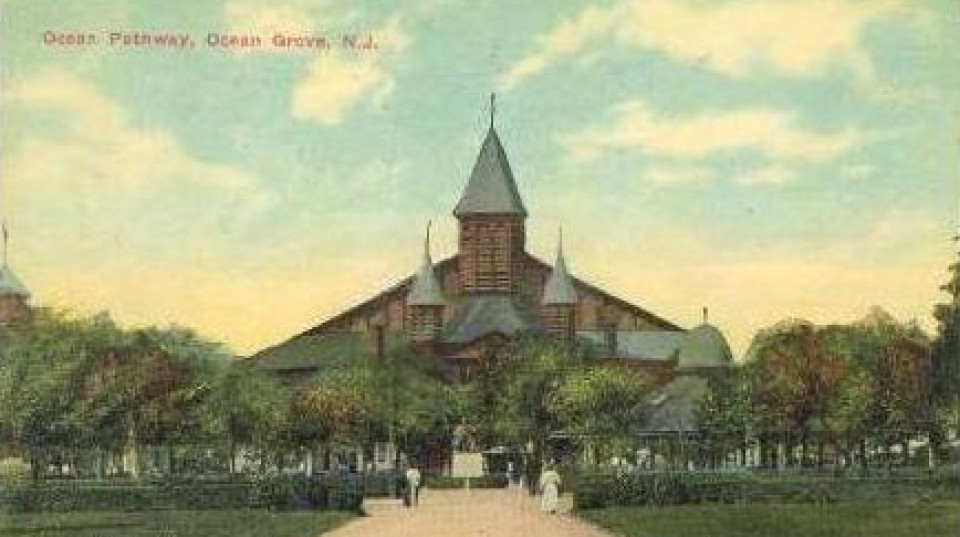
THE GREAT AUDITORIUM easily dominates the social, religious and cultural life of Ocean Grove, New Jersey.  It plays an important role in 190 MOUNT TABOR WAY, too.

Popular hymn writers visit Ocean Grove each summer, including the historic figures mentioned in Chapter 3. During the Centennial year of the Great Auditorium, an evening service celebrated their hymns. But Senior Artist in Residence and Music Director, Peter deMeer, is fictional, as is his title. Since 1974, the resident organist for the Great Auditorium has been Dr. Gordon Turk, a prominent American concert organist.

The Auditorium Organ is one of the world’s great organs. Since 1974 it has been expanded to 186 ranks and 11,550 pipes. The work was initiated and guided by Dr. Gordon Turk and Organ Curator, John R. Shaw. Dr. Turk presented the Organ Centennial Concert to mark the organ’s dedicatory recital held on July 3, 1908. The project of restoring and expanding the organ is a story in itself.

Dr. Turk offers organ recitals on most Wednesday evenings and Saturday afternoons during July and August. Attending a recital in the Great Auditorium with the sea air blowing through the open doors on three sides is a memorable experience.

Jay Ward Thomas III, speaker for Camp Meeting, is also a fictional character as is his great uncle, Jay Ward Thomas.  In the book, the senior Thomas is remembered as a famous inspirational writer and speaker who was a frequent visitor to Ocean Grove and spoke at the Great Auditorium.  The Camp Meeting Association has been host to many such guests, but not these two!

The list of famous people who have performed at the Great Auditorium, included in chapter 3, is not fictional. It only begins to capture the range of personalities who have been there.  Family entertainment and cultural events in the Auditorium and at the Grove are scheduled every summer and may be found on the Ocean Grove website http://www.oceangrove.org.

As an aside: I recall when Peter, Paul and Mary were regulars at the Great Auditorium. Their songs of hope and call to action inspired me from the time I was a college student. When they performed at my university in the late 1960s, I couldn’t afford tickets. I’ll never forget the review of their performance that appeared in the university’s student paper. The headline read something like: Mary! And those other guys. Mary! Peter Yarrow, Noel (Paul) Stookey and Mary Travers reminded us that folk music can be a force for social action. Their website carries a loving tribute to Mary, who died in 2009.

Further Reading: Troy Messenger looks at the history of Ocean Grove through performance in Holy Leisure: Recreation and Religion in God’s Square Mile (University of Minnesota Press, 1999; Temple University Press, 2001).  Wayne T. Bell, Cindy L. Bell and Darrell A. Dufresne’s book The Great Auditorium, Ocean Grove’s Architectural Treasure documents the history and significance of the structure itself.

A Street Named Mt. Tabor Way–occasional note

17 Monday Mar 2014

Posted by Frances St.Clair in About the The House at Mt. Tabor, The House at Mt. Tabor

≈ 2 Comments

Tags

NJ, Ocean Grove, streets in Ocean Grove, streets with Biblical names

Mount Tabor Way is an actual street in Ocean Grove, NJ, though the house number 190 doesn’t exist–or at least it didn’t in 1994, the 100th Anniversary of The Great Auditorium. Graced by many lovely Victorian homes and Greenleaf Park, the street begins at Pilgrim Pathway and stretches to #143, where it turns into Benson Avenue.  It’s a bright, cheerful street, even in the winter when the trees have long-since lost their foliage and their branches create lace patterns against the sky. I chose the street as the setting for 190 MOUNT TABOR WAY because I’ve stayed in one of the houses there, the house that inspired the title.

Many street names in Ocean Grove take their names from the Hebrew and Christian Bibles. Many Christians believe Mount Tabor is the mount where Jesus was transfigured. A description of the mount and Biblical references may be found at the Sacred Destinations website: http://www.sacred-destinations.com/israel/mount-tabor. (The site is ecumenical and offers descriptions and pictures of the sacred places of all faith traditions.)

The street may be most famous as the original site of Mrs. Wagner’s Home Made Pies. Once located at 124-126, a business that eventually moved to Brooklyn, NY and closed in 1969.  Mrs. Wagner’s original site is part of the Historical Society’s Women’s Trail http://www.oceangrovehistory.org/WomansTrail.html.

So why a cozy mystery?occasional note

13 Thursday Mar 2014

Posted by Frances St.Clair in So why a cozy mystery?, The House at Mt. Tabor

≈ Leave a comment

Tags

amateur women sleuths, cozy mysteries, mother daughter mysteries

I didn’t set out to write a cozy mystery, I had a story to tell. When it came time to label the story, cozy mystery seemed the best description.  Usually, a cozy mystery is a small town story featuring an amateur sleuth. Very often the sleuth is a woman who happens to be a keen observer and who has her wits about her—a Miss Marple, for example. The sleuth is able to fly in under the radar because she isn’t seen as particularly threatening.

Like other cozy mysteries, THE HOUE AT 190 MOUNT TABOR WAY is a wholesome story that deals with unwholesome motives and events without getting overly explicit about sex and violence.  But, caution to the reader: upon entering into the languid description of Ocean Grove and the house at 190, it isn’t a good idea to gear down with Carrie and her daughter Elizabeth.  Things aren’t going to be as uncomplicated and comfortable as they seem. There are details to be noticed along the way. Carrie and Elizabeth aren’t noticing them at first, to their regret and almost to their peril. But forewarned, the reader may notice them.

In a cozy mystery, there’s a puzzle that has to be solved.  One of the things I enjoy in a good mystery is trying to solve the puzzle first, before the author tells all! Maybe even before the sleuth. To get herself and Elizabeth out of harm’s way, Carrie has to grapple with two unrelated but interlocking puzzles. In the final chapter, Elizabeth tells her that in the ancient genera of the Chinese mystery, there are three unrelated plots that the detective must untangle. Carrie has untangled two. Elizabeth offers her opinion about the third, but I wouldn’t want to spoil your fun. Hopefully, you’ll have a chance to read the whole story. I am actively seeking a publisher. For now, I’m posting the first three chapters. I’ve also included links about the very real context, Ocean Grove, New Jersey.


Recent Posts

  • Death of a Mentor
  • Occasional note: Postpartum Blues and Black Holes
  • Thanks for the support
  • Jay Ward Thomas–occasional note
  • Memorable Breakfasts–occasional note

Recent Comments

Frances St.Clair's avatarFrances St.Clair on Occasional note: Postpartum Bl…
Frances St.Clair's avatarFrances St.Clair on Thanks for the support
Liesl's avatarLiesl on Thanks for the support
Frances St.Clair's avatarFrances St.Clair on A Street Named Mt. Tabor Way…
Liesl's avatarLiesl on A Street Named Mt. Tabor Way…

Archives

  • November 2015
  • November 2014
  • October 2014
  • August 2014
  • July 2014
  • June 2014
  • May 2014
  • April 2014
  • March 2014

Categories

  • About the The House at Mt. Tabor
  • Characters
  • Shorts
  • So why a cozy mystery?
  • The House at Mt. Tabor

Meta

  • Create account
  • Log in
  • Entries feed
  • Comments feed
  • WordPress.com

Recent Posts

  • Death of a Mentor
  • Occasional note: Postpartum Blues and Black Holes
  • Thanks for the support
  • Jay Ward Thomas–occasional note
  • Memorable Breakfasts–occasional note

Recent Comments

Frances St.Clair's avatarFrances St.Clair on Occasional note: Postpartum Bl…
Frances St.Clair's avatarFrances St.Clair on Thanks for the support
Liesl's avatarLiesl on Thanks for the support
Frances St.Clair's avatarFrances St.Clair on A Street Named Mt. Tabor Way…
Liesl's avatarLiesl on A Street Named Mt. Tabor Way…

Archives

  • November 2015
  • November 2014
  • October 2014
  • August 2014
  • July 2014
  • June 2014
  • May 2014
  • April 2014
  • March 2014

Categories

  • About the The House at Mt. Tabor
  • Characters
  • Shorts
  • So why a cozy mystery?
  • The House at Mt. Tabor

Meta

  • Create account
  • Log in
  • Entries feed
  • Comments feed
  • WordPress.com

Blog at WordPress.com.

  • Subscribe Subscribed
    • The Mild Mannered Professor Mysteries
    • Already have a WordPress.com account? Log in now.
    • The Mild Mannered Professor Mysteries
    • Subscribe Subscribed
    • Sign up
    • Log in
    • Report this content
    • View site in Reader
    • Manage subscriptions
    • Collapse this bar